Time blocking can help people with ADHD. It can also become one more beautiful plan that collapses by 10:30.
That is not a character flaw. It is usually a design problem. If the plan is too rigid, too detailed, or too disconnected from real energy, it turns into pressure. If the plan is too vague, the day disappears into meetings, messages, and task switching.
The useful version sits in the middle: visible enough to start, flexible enough to survive the day.
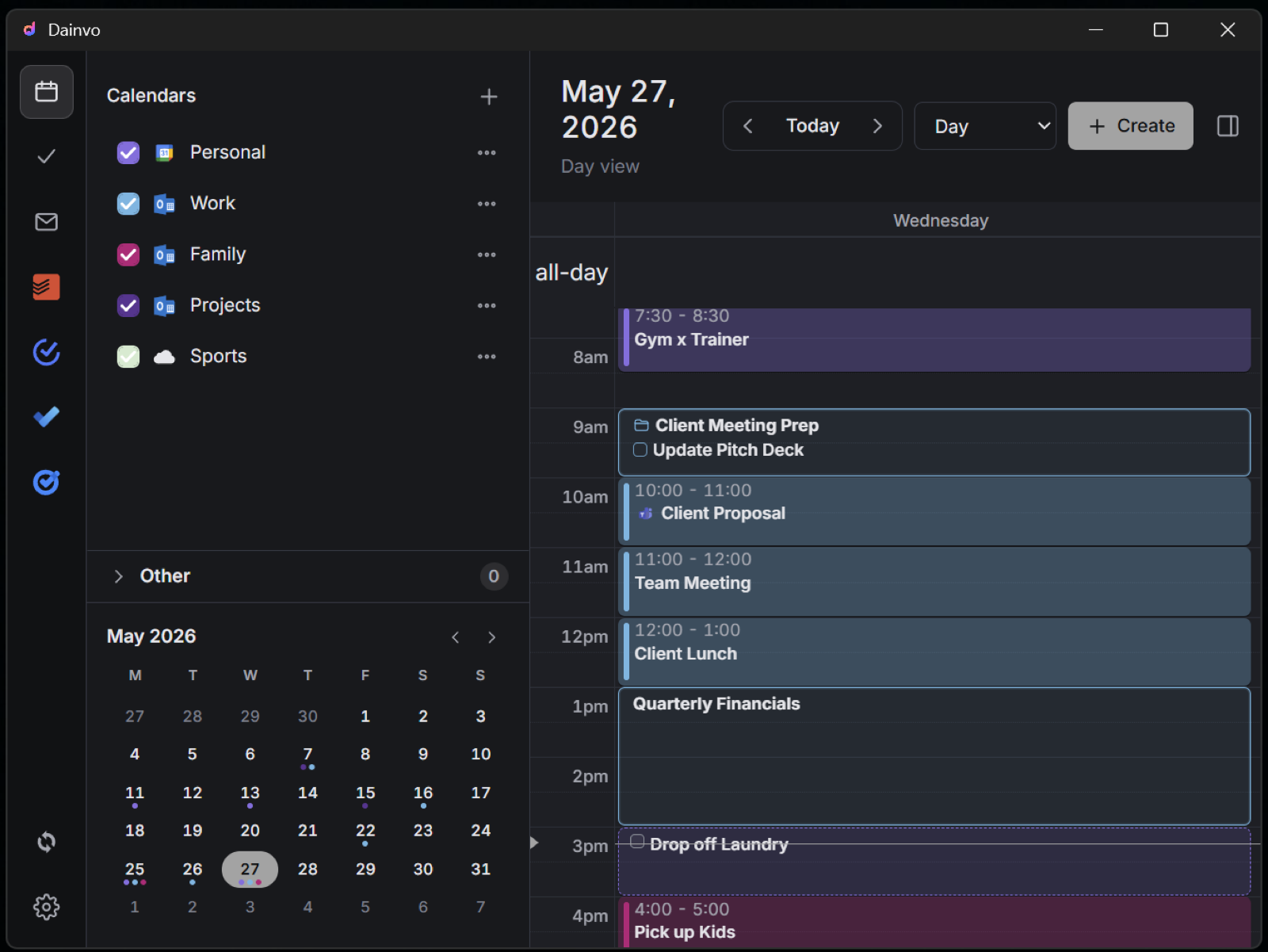
Dainvo is a good fit for that kind of planning because it combines calendars, tasks, buckets, notes, meeting links, and files in one desktop workspace. Used well, it can make time feel less abstract without turning the calendar into a prison.
Quick answer
ADHD time blocking works best when you schedule fewer things, make the first step obvious, and leave room for recovery between blocks.
Use Dainvo to block the tasks that truly need protected time. Use buckets when one focus session contains several small tasks. Keep notes and files close to the block so starting takes less effort. Do not schedule every minute.
That last part is important. A time block is a support tool, not a promise you use to punish yourself later.
Why time feels different with ADHD
Many people with ADHD struggle with time in a very practical way. A task can feel like it will take ten minutes and then eat an hour. A meeting at 2 PM can make the whole morning feel unusable. A deadline next week can feel unreal until it is suddenly too close.
Research backs up the idea that time perception can be a meaningful part of ADHD. A review on time perception in ADHD describes ADHD as a lifelong neurodevelopmental condition that can affect daily life and executive function, and it discusses evidence that time perception difficulties may be clinically relevant (Clinical Implications of the Perception of Time in ADHD).
That is why a plain to do list can fail. Lists do not show time. They show intention.
Time blocking helps because it turns intention into a visible shape. The question changes from "what should I do?" to "what can fit here?"
Why overplanning backfires
A lot of ADHD productivity systems fail because they ask for too much planning up front.
Every task gets a time. Every break gets a label. Every hour has a purpose. It looks great. Then one meeting runs long, one message turns urgent, or one task takes twice as long as expected. The whole plan starts to feel broken.
Once the plan feels broken, it is easy to abandon it completely.
Dainvo works better when you use it lightly. Put fixed events on the calendar. Pick a few tasks that need real time. Create one or two focus blocks. Add a bucket when a block has several pieces. Then stop.
A realistic plan beats a perfect plan that only works on paper.
Start with fixed time
The first step is not choosing tasks. It is seeing the shape of the day.
Open Dainvo and look at what is already fixed: meetings, appointments, travel, family commitments, classes, calls, and deadlines. Those are the walls of the room. The tasks have to fit inside them.
This is especially useful for ADHD because it reduces guesswork. Instead of holding the day in your head, you can see it. If the calendar is already chopped into small pieces, do not pretend you have three hours of deep work available. You do not.
That is not failure. That is information.
Pick fewer tasks than you think
The most ADHD-friendly time block is often the one you actually start.
Choose one to three tasks that need protected time today. Not twenty. Not the whole backlog. Just the work that needs a real place on the calendar.
In Dainvo, those tasks can come from Dainvo Tasks or connected task apps like Todoist, Microsoft To Do, Google Tasks, TickTick, or Obsidian. The important part is not where the task came from. The important part is deciding whether it deserves time today.
If it does, schedule it. If it does not, leave it visible but unscheduled.
That separation matters. Unscheduled does not mean forgotten. It means "not now."
Use buckets for work that has many pieces
Some focus blocks are not one task. They are a small project hiding inside one line.
"Apply for job" might mean updating the resume, checking a folder, writing a cover letter, finding the posting, and sending the email. "Prepare for meeting" might mean reviewing notes, opening a deck, checking a spreadsheet, and writing questions.
If you schedule every tiny piece separately, the calendar gets noisy. If you schedule only the big task, the first step may still feel too large.
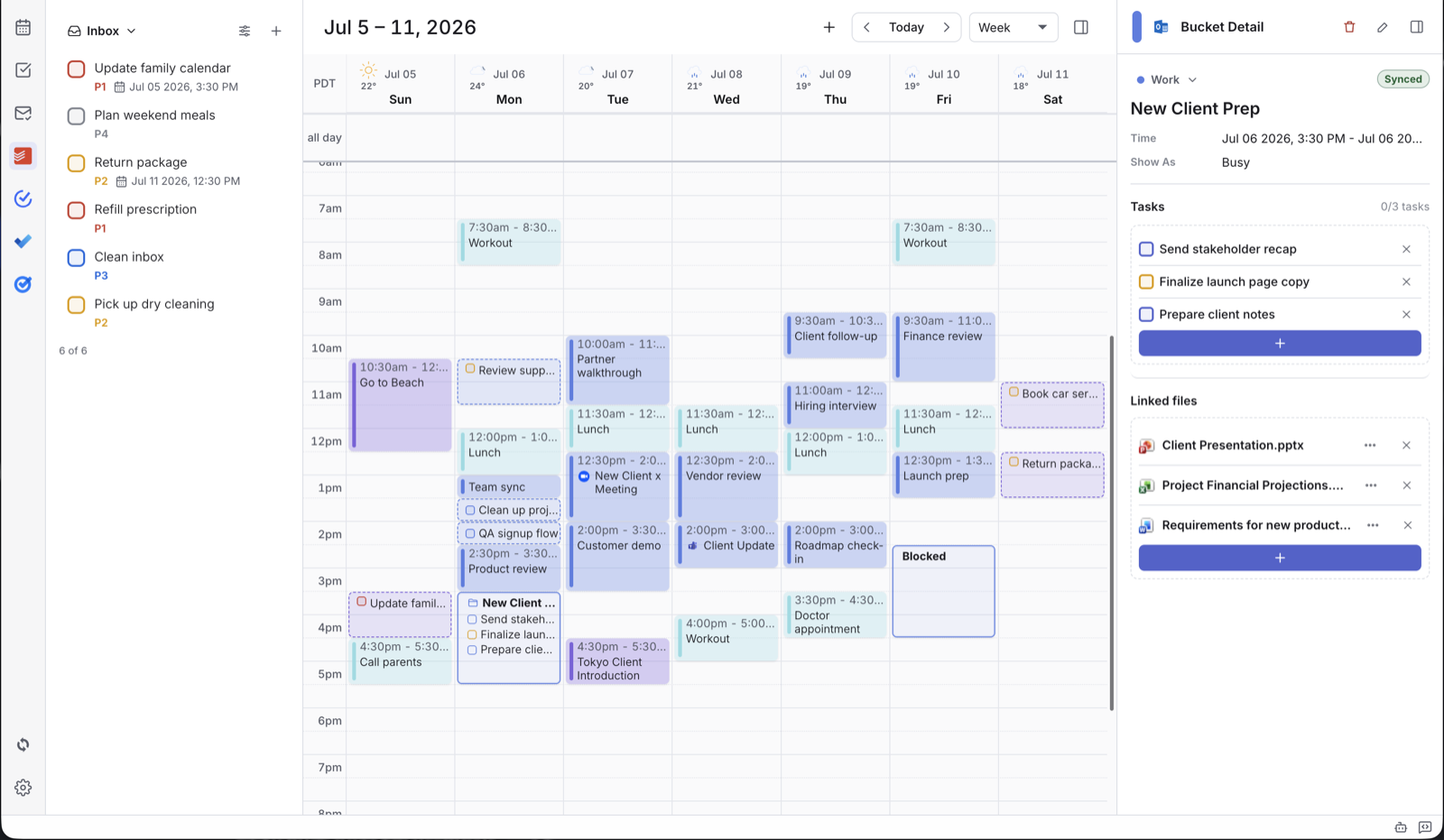
Dainvo buckets solve that problem. A bucket is a block of time for a group of related work. You can attach tasks and link local files or folders. When the block starts, the pieces are already together.
For ADHD, that can reduce start friction. You are not asking your brain to remember the setup. The setup is visible.
Make the first action embarrassingly clear
A useful time block should answer one question: what do I do first?
Not the whole project. Not the perfect plan. Just the first action.
Bad block: "Work on taxes."
Better block: "Open tax folder and sort receipts for 20 minutes."
Bad block: "Research competitors."
Better block: "Open saved links and write five notes."
Dainvo helps because you can keep a note, task, and file link near the block. If the first action is visible, you are less likely to spend the block warming up, searching, or reorganizing the plan.
Add transition time on purpose
ADHD focus can be fragile around transitions. Switching from a meeting to writing, from errands to admin, or from messages to deep work may take longer than expected.
Do not stack blocks like a machine. Add space.
A five minute transition can be enough to review the next block, open the right file, stand up, or reset after a call. If a meeting is emotionally heavy or mentally demanding, add more room. The calendar should reflect the human doing the work, not an imaginary version of you with perfect context switching.
Dainvo can help because the day view makes those edges visible. You can see when blocks are too tight before the day proves it for you.
Use daily notes as a parking lot
One reason focus breaks is that the brain keeps throwing unrelated reminders into the room.
Do not fight every thought. Park it.
Use Dainvo daily notes as a simple place to catch the things that appear while you are trying to focus: a reminder, a question, a loose idea, a follow up, a thing to check later. You can come back to it after the block.
This works because it gives the thought somewhere to go. You are not ignoring it. You are also not letting it take over the current block.
Use reminders carefully
Reminders can help. Too many reminders become noise.
For ADHD, the goal is not to create constant alerts. The goal is to put attention back where it belongs at the right moment. Use reminders for events and tasks that truly need a nudge. Do not use them to recreate the whole task list as a notification storm.
Dainvo works best when reminders are paired with visible planning. The calendar shows the day. Task blocks show the work. Reminders only support the moments that need extra help.
What the science suggests
ADHD support often works best when it uses skills and structure rather than shame. Research on cognitive behavioral therapy for adult ADHD describes treatment approaches that teach practical executive function skills, including organization, planning, and attention management (CBT for ADHD in Adults).
That maps well to time blocking. A block is not magic. It is a structure. It helps the user decide when to start, what to start with, and what to ignore for now.
CHADD also notes that adults with ADHD may have difficulties with attention, executive function, and working memory, and that executive function affects prioritizing and managing actions over time (CHADD). A planner cannot remove those challenges, but it can make fewer things depend on memory alone.
A Dainvo routine for ADHD focus
Try this for one week.
- Open Dainvo once in the morning.
- Check fixed events first.
- Choose one main focus block.
- Choose one backup task for low energy time.
- Create a bucket if the focus block has several pieces.
- Link the file or folder you need before the block starts.
- Write one sentence in daily notes: "Today counts if I do this."
- Leave blank space between meetings and focus blocks.
That routine is intentionally small. The more complicated it gets, the less likely it is to survive a bad day.
Where Dainvo helps most
Dainvo is especially useful when your ADHD productivity problem is not knowing what to do next, losing track of tasks across tools, underestimating time, forgetting the context for a work block, or spending too much energy setting up before you start.
It helps less if the main issue is clinical treatment, sleep, medication questions, or workplace accommodations. Those deserve proper support from clinicians, coaches, managers, or other qualified people.
The planner can help with the shape of the day. It should not pretend to be the whole answer.
FAQ
Is time blocking always good for ADHD?
No. Time blocking can help when it is flexible and realistic. It can backfire when every minute is scheduled or when the plan becomes a source of shame. Start with one or two blocks, not a perfect calendar.
How long should an ADHD focus block be?
Short enough that you will start. For some people that is 20 minutes. For others it is 45 or 60. The right length depends on the task, energy, and day. If you keep skipping a block, make it smaller.
Should I use Dainvo buckets or task blocks?
Use a task block when one task needs time. Use a bucket when a work session has several related tasks, notes, or files. Buckets are helpful when the work would otherwise feel like a messy pile.
Can Dainvo replace ADHD treatment?
No. Dainvo is a planning app, not a medical treatment. It can support organization and focus routines, but it does not replace diagnosis, therapy, coaching, medication, or medical advice.
Try Dainvo
If time keeps slipping away because tasks, meetings, notes, and files live in different places, Dainvo can give your day a clearer shape. Start small. One focus block, one bucket, one visible next step.