ADHD productivity advice gets annoying fast. Too much of it sounds like "just use a planner," as if the hard part is buying the notebook or downloading the app.
For a lot of people with ADHD, the hard part is not wanting to do the work. It is starting the work, remembering the work exists, judging how long it will take, and switching into it without losing the thread. That is a different problem.
Dainvo is not a treatment for ADHD. It is not a medical tool. But a planner can still help if it is designed around the parts of work that ADHD often makes harder: time awareness, task initiation, working memory, and follow through.
Quick answer
A useful ADHD planner should make the next step visible, reduce the number of places you have to check, and turn vague tasks into time you can actually see.
Dainvo helps by putting calendars, tasks, meetings, notes, buckets, and local file links in one desktop workspace. That means fewer open tabs, fewer hidden task lists, and fewer moments where you have to reconstruct the plan from memory.
This matters because ADHD is strongly tied to executive function difficulties. CHADD describes executive function as the brain's ability to prioritize and manage thoughts and actions over time, and notes that people with ADHD may struggle with attention, working memory, task completion, and remembering important things (CHADD).
ADHD productivity is not about trying harder
ADHD is a neurodevelopmental disorder that can involve persistent patterns of inattention, impulsivity, and hyperactivity. NIMH describes ADHD symptoms as patterns that interfere with functioning or development (NIMH). The CDC also describes ADHD as involving symptoms that can affect daily life, school, work, and relationships (CDC).
That matters for productivity. If the issue is executive function, then a moral lecture will not fix it. "Be more disciplined" is not a system. "Try harder" does not create time awareness. "Just remember" is a bad plan when working memory is already under strain.
A better approach is to make the environment do more of the remembering. Put the work where you can see it. Break the day into visible blocks. Keep the file, note, meeting link, and task close together. Lower the amount of mental assembly required before starting.
That is where a tool like Dainvo can help.
The ADHD problem Dainvo is trying to solve
A normal workday asks for a surprising amount of invisible coordination.
You check the calendar. Then the task app. Then the meeting invite. Then the note from yesterday. Then the folder where the file lives. Then you try to remember which task was urgent and which one only felt urgent because it was loud.
That is a lot of context switching before the work even starts.
For someone with ADHD, that switching can be costly. Research on executive function describes skills such as working memory, inhibition, shifting attention, and goal directed behavior as central to everyday functioning (Executive Dysfunction review). When those skills are under pressure, the best planner is not the one with the most buttons. It is the one that reduces the amount of juggling.
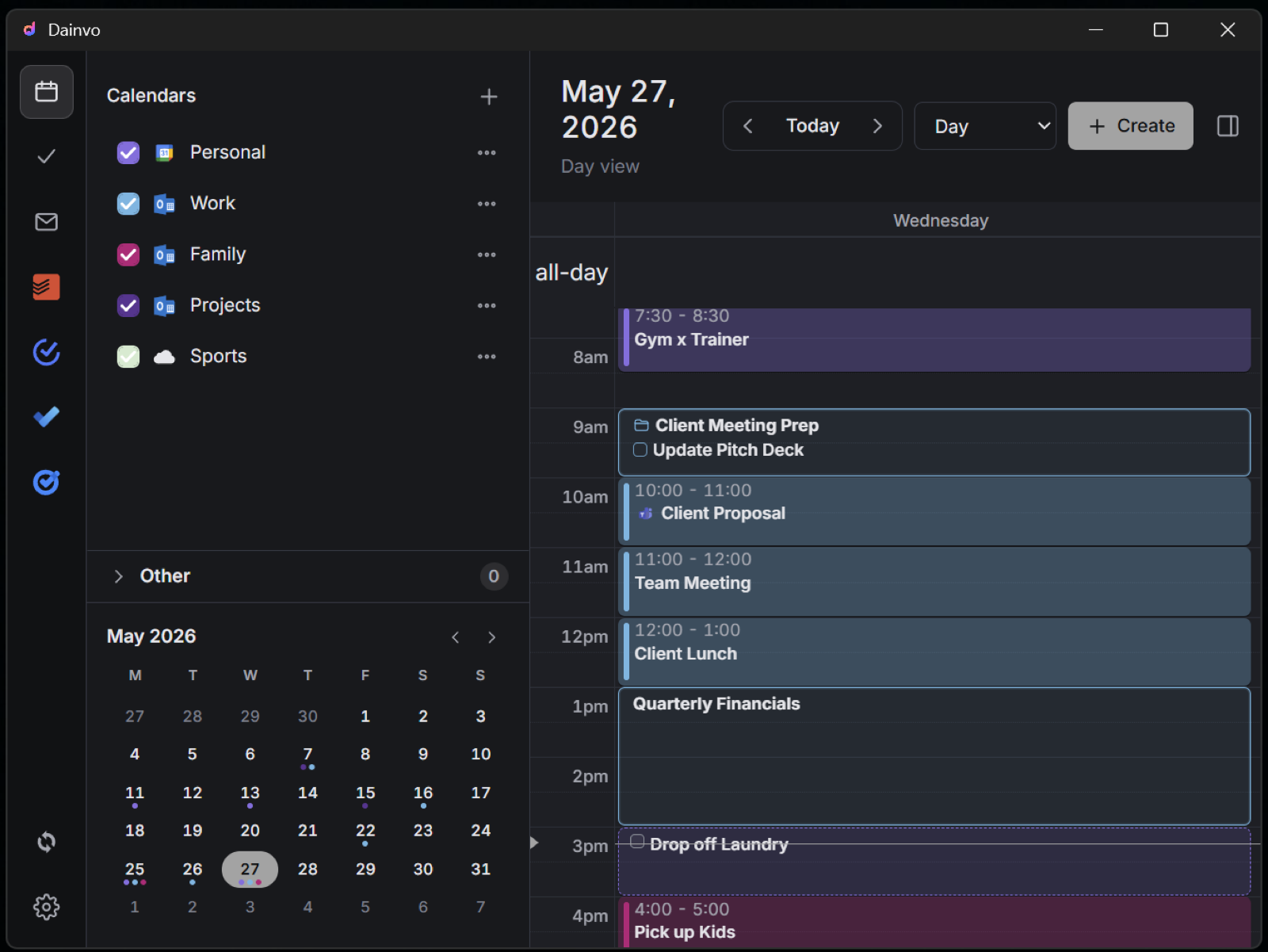
Dainvo brings the pieces of the day into one view:
- calendar events for fixed time
- tasks for open work
- task blocks for work you plan to do at a specific time
- buckets for a group of related tasks
- daily notes for context
- meeting links for calls
- local file and folder links for the materials you need to start
The point is simple: less hunting, more starting.
Feature 1: One daily view reduces the "where was that?" problem
A common ADHD productivity failure is losing work because it lives somewhere else. The task is in Todoist. The meeting is in Google Calendar. The file is on the desktop. The note is in Obsidian. The follow up is in Outlook.
Each place makes sense on its own. Together, they become friction.
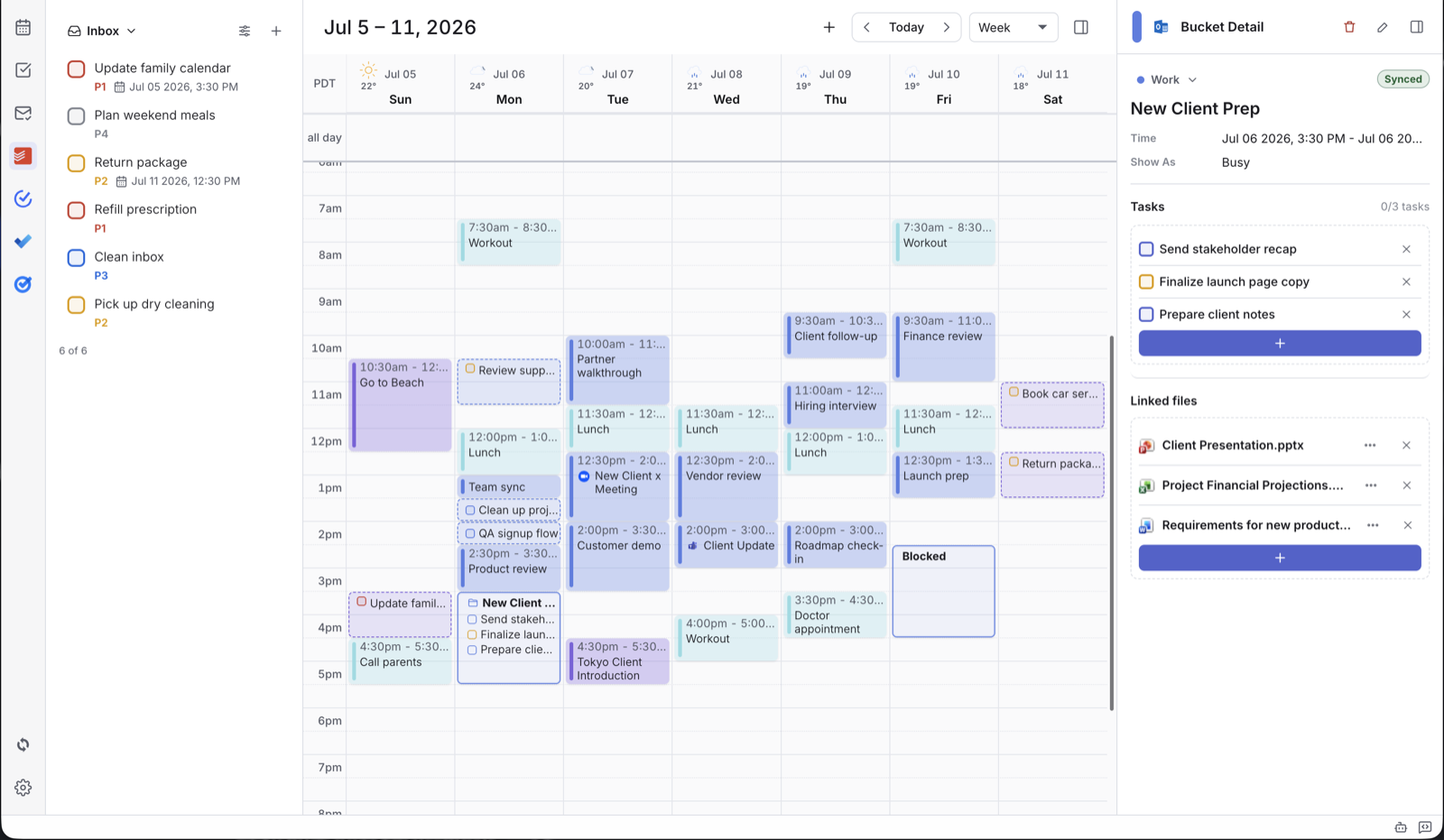
Dainvo's daily planning view helps by putting time and work beside each other. You can see what is already booked, what tasks are waiting, and what has been scheduled into the day. Instead of asking "what app was that in?" you can ask a better question: "what can I do next?"
That matters for ADHD because external structure can reduce the burden on memory. You do not have to hold the plan in your head if the plan is visible.
Feature 2: Time blocks make time less abstract
Many people with ADHD talk about time blindness: time feels too vague, too slippery, or too easy to misjudge. A review on time perception in ADHD notes that ADHD is associated with difficulties in time perception and time related behavior, and discusses how those issues can affect daily life (Clinical Implications of the Perception of Time in ADHD).
That does not mean every ADHD person experiences time the same way. But it does explain why a list of tasks can be misleading. A list does not show whether the work fits.
Dainvo lets you turn a task into a visible block of time. That does two useful things.
First, it makes the task more real. "Write report" is vague. "Work on report from 10:00 to 11:00" is easier to start.
Second, it shows the tradeoff. If the morning already has three meetings, two errands, and one call, there may not be room for a large task. That can feel disappointing, but it is better than blaming yourself at 6 PM for not doing work that never had a realistic place to happen.
Feature 3: Buckets help when a task is really a pile
Some tasks are not tasks. They are piles.
"Prepare for client meeting" might include reviewing a document, checking an email thread, updating a slide, writing two questions, and opening the right folder. If that whole pile sits as one task, it can feel too big to start. If every tiny step becomes its own calendar event, the calendar becomes ridiculous.
Dainvo buckets are built for that middle ground. A bucket reserves time for a group of work. You can add related tasks and link the local files or folders you need.
For ADHD, this can help with task initiation. The work block is visible, but the pieces are not scattered. When the block starts, you do not have to rebuild the setup. You open the bucket and begin with the first visible item.
Feature 4: Daily notes keep context close
A lot of productivity tools treat notes as separate from planning. That can be a problem.
For ADHD, context can disappear quickly. You may remember that a task matters, but not why. You may remember that a meeting happened, but not the one decision you need to act on. You may have a good idea in the morning and lose it by lunch.
Dainvo daily notes give each day a place for context. You can use them for a short morning plan, a messy brain dump, meeting notes, or the three things you do not want to forget.
This is not about writing a perfect journal. It is about keeping the day's memory close to the day's schedule.
Feature 5: Meeting links and files reduce start friction
Starting is easier when the first action is obvious.
If a work block starts and you still have to find the meeting link, the file, the note, and the task, the block is already leaking energy. Dainvo helps by keeping meeting actions and local file links near the work.
That is not glamorous, but it is practical. ADHD productivity often improves when the environment removes small barriers. If the deck is linked to the bucket, the task is visible, and the time is already blocked, the first step is smaller.
A simple ADHD-friendly Dainvo routine
Do this once in the morning. Keep it short.
- Open Dainvo and look at fixed time first.
- Pick one to three tasks that truly need time today.
- Drag those tasks into the calendar or create a bucket for grouped work.
- Link any file or folder you need before the block starts.
- Add one short daily note: "If I do nothing else, do this."
- Stop planning.
The last step matters. Planning can become avoidance. The goal is not a perfect day. The goal is a visible next step.
What the science says about skills, not shame
Research on cognitive behavioral therapy for adult ADHD often focuses on practical skills: organization, planning, distractibility management, and coping strategies. One CBT description notes that adult ADHD treatment may include compensatory executive functioning skills, including organizing and planning techniques and attention strategies (CBT for ADHD in Adults).
That is the useful frame for productivity software. The app should not shame the user into being different. It should support the skills that are hard to perform consistently.
Dainvo can help with that by making the day visible, reducing scattered context, and helping tasks become planned time.
What Dainvo cannot do
Dainvo cannot diagnose ADHD. It cannot replace therapy, coaching, medication, sleep, exercise, workplace accommodations, or medical care. If ADHD symptoms are causing serious problems in your life, talk to a qualified clinician.
A planner is only one part of the support system.
But the right planner can remove friction. That matters. A good tool cannot do the work for you, but it can make the first step easier to find.
FAQ
Is Dainvo designed only for ADHD?
No. Dainvo is a daily planner for calendars, tasks, meetings, notes, and files. The same features that help busy professionals can also help people with ADHD because they reduce hidden work and make the day easier to see.
Is time blocking good for ADHD?
It can be, especially when the blocks are realistic and flexible. Time blocking works best when it makes time visible without turning the day into a punishment. Keep blocks short enough to start and leave room for the day to change.
What is the best Dainvo feature for ADHD productivity?
Start with the day view and task blocks. Seeing fixed events beside planned work is the fastest way to understand what the day can actually hold. Buckets are useful when one work session has several small tasks or files attached.
Should I schedule every task?
No. That usually creates a fake plan. Schedule only the tasks that need protected time. Leave smaller tasks visible, but unscheduled.
Try Dainvo
If your task list keeps growing but the day never feels clear, try using Dainvo as the place where calendars, tasks, meetings, notes, and files come together. The goal is not to become a different person. The goal is to make the next step easier to see.